
🚨 THE FACTS: OSU’S INCENTIVE PAY CRISIS (11/14)
What OSU executives are telling nurses. What actually happened at the bargaining table. And why patient safety is on the line.
OSU executives have spent weeks attempting to control the narrative around the incentive pay crisis. Their latest FAQ continues that pattern, misrepresenting our bargaining position, blaming nurses for staffing instability, and avoiding accountability for decisions that have disrupted patient care.
On November 14, 2026, we formally delivered a demand to OSU executives for an OPEN bargaining session, with both bargaining teams at the table and ONA/OSUNO members invited to observe. No more scripted talking points. No more spin. Let nurses hear the proposals, witness the negotiations, and decide for themselves.
OPEN THE DOORS. LET OUR MEMBERS HEAR THE TRUTH.
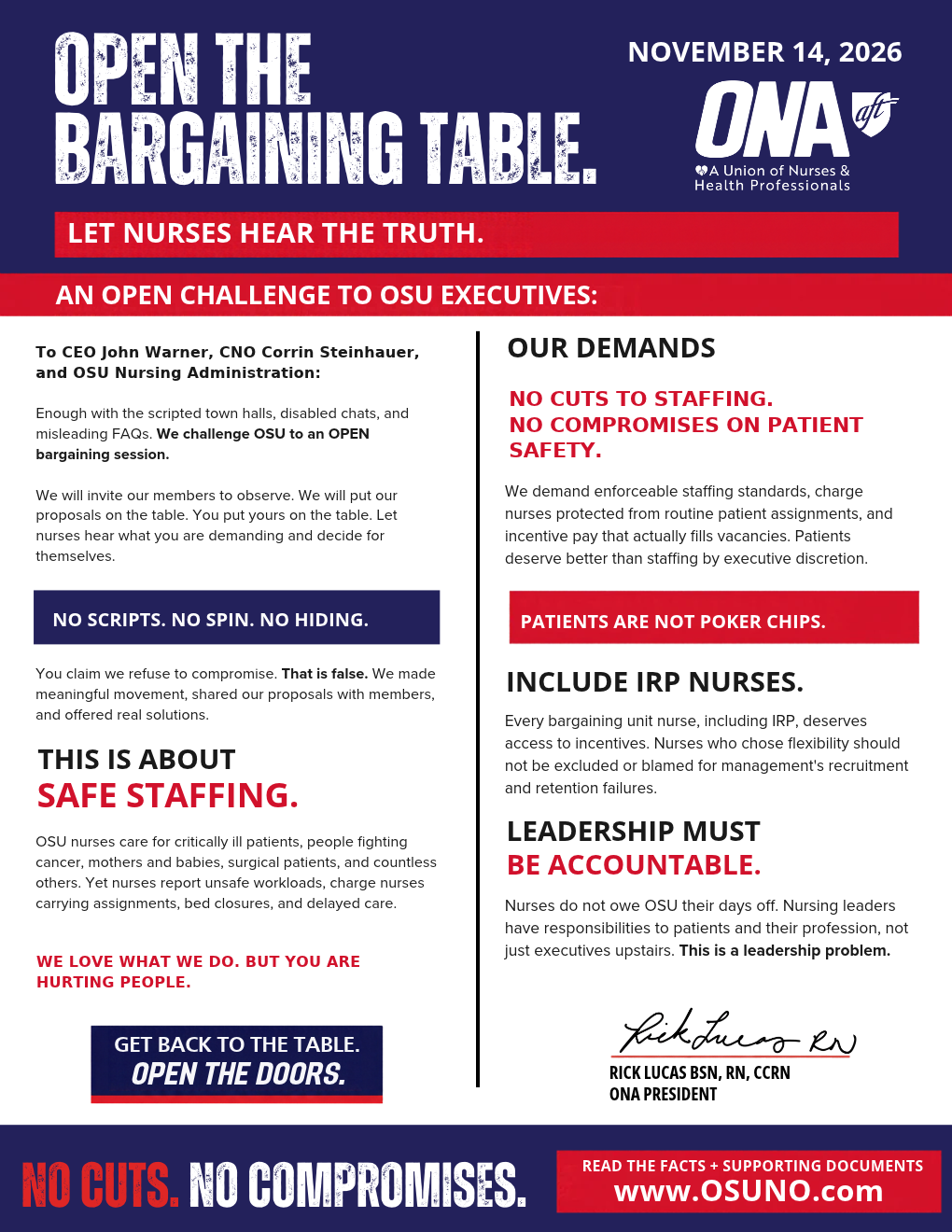 (Click the image to read our full open bargaining demand.)
We’re setting the record straight. And we’ve got receipts. 🧾
✊ 1. THE TRUTH ABOUT BARGAINING
❓ Did ONA/OSUNO refuse to compromise?
Absolutely not.
OSU administration has attempted to portray our position of “No Cuts. No Compromises.” as evidence that we refused to negotiate.
That’s a deliberate misrepresentation.
Our message has always been:
🚨 NO CUTS TO STAFFING. NO COMPROMISES ON PATIENT SAFETY.
We made significant movement at the bargaining table. We developed alternative proposals, offered solutions, and worked to find common ground.
We shared our latest proposal with our members. They can see exactly where we moved and what we offered.
OSU executives cannot rewrite the bargaining history simply because our members rejected their proposals.
❓ Why did members reject OSU’s proposals?
Because incentive pay is about more than an hourly dollar amount.
Our members want a program that:
-
✅ Provides meaningful incentives to fill critical vacancies.
-
✅ Includes all bargaining unit nurses, including IRP.
-
✅ Helps maintain contractual staffing ratios.
-
✅ Keeps charge nurses out of routine patient assignments.
-
✅ Contains enforceable safeguards against unsafe staffing.
-
✅ Does not leave critical decisions entirely to management’s discretion.
OSU’s proposals have failed to adequately address those priorities.
❓ Has ONA/OSUNO refused to return to bargaining?
No. We have repeatedly expressed our willingness to meet, negotiate, and reach an agreement.
We even proposed temporarily restoring the previous incentive pay program through January 9, 2027, while negotiations continued.
Our position is that nurses and patients should not have to suffer while management refuses to agree to a workable solution.
❓ Why are you demanding an open bargaining session?
Because OSU continues to publicly misrepresent what happens at the table.
Their town hall promised answers and transparency, but members were presented with scripted responses and a disabled chat.
So let’s eliminate the middlemen.
📣 WE ARE CHALLENGING OSU TO AN OPEN BARGAINING SESSION THAT OUR MEMBERS CAN OBSERVE.
We’ll put our proposals on the table. Management can put theirs on the table. Nurses can listen to the actual conversation and draw their own conclusions.
If OSU executives believe their proposals are so reasonable, why wouldn’t they welcome that opportunity?
🏥 2. STAFFING: THE REAL ISSUE
❓ Isn’t this just a dispute over incentive pay?
No. It’s a dispute over patient safety and management accountability.
OSU has depended heavily on nurses voluntarily working additional hours to fill vacancies and support hospital operations.
For more than a decade, incentive pay has helped encourage nurses to work beyond their regularly scheduled commitments.
When that program expired on September 30, 2026, OSU did not have a sustainable alternative in place.
That failure belongs to management.
Nurses continue working the hours they were hired to work. They are not obligated to sacrifice their days off to compensate for inadequate staffing.
❓ What are nurses reporting?
🚨 Nurses have reported:
-
Critical care nurses caring for three patients or managing multiple highly complex patients.
-
Charge nurses carrying patient assignments instead of being available to support their units.
-
Medical-surgical units operating with excessive workloads.
-
Patients waiting for necessary procedures and surgeries.
-
Closed hospital beds because of insufficient staffing.
-
Delayed transfers and patients unable to access available hospital services.
-
Nurses experiencing extraordinary physical and emotional exhaustion.
- Patients boarding in the ED and waiting in the lobby for more than 12 hours to receive care. Many simply leave.
These are not abstract staffing statistics. These are conditions affecting real patients and the professionals caring for them.
Nurses have repeatedly documented these concerns through Assignments Despite Objection (ADO) forms.
📄 On November 9, nurses delivered more than 5,000 pages of staffing and safety documentation to management offices.
MANAGEMENT CANNOT CLAIM IT WASN’T WARNED.
❓ What do ONA/OSUNO members want?
We want enforceable staffing protections.
When the hospital cannot meet established staffing standards, it must take meaningful steps to address those shortages.
That includes offering incentives sufficient to fill critical vacancies and protecting charge nurses from being routinely pulled into patient assignments.
OSU wants broad discretion over when to offer incentives and which vacancies warrant additional compensation.
That’s the fundamental disagreement.
WE WANT ACCOUNTABILITY. MANAGEMENT WANTS DISCRETION.
Patients should never be left wondering whether an executive decided their shift was worth staffing appropriately.
🃏 OUR PATIENTS ARE NOT POKER CHIPS.
❓ Why can’t nurses just pick up more shifts?
Because nurses are human beings, not an unlimited labor supply.
They have families. Children. Responsibilities. Lives outside the hospital.
They already work physically exhausting and emotionally demanding jobs, often under extremely difficult conditions.
They have every right to rest, spend time with their families, and make their own decisions about voluntary extra work.
OSU DOES NOT OWN OUR TIME AWAY FROM WORK.
A staffing model that depends on nurses continually sacrificing their personal lives is not a sustainable staffing model.
It’s a management failure disguised as workforce planning.
⚖️ 3. THE IRP CONTROVERSY: PUNISHING THE NURSES WHO STAYED
❓ Why is ONA/OSUNO insisting that IRP nurses be included?
Because IRP nurses are bargaining unit nurses who provide essential patient care.
They bring clinical expertise, experience, and scheduling flexibility that the hospitals depend on.
Many chose IRP because they wanted greater control over their schedules and personal lives.
Others moved away from traditional positions after becoming exhausted by inflexible scheduling, unsupportive managers, and working conditions that made their previous roles unsustainable.
They didn’t stop wanting to be nurses. They stopped wanting to work under the conditions management created.
Their contributions should be valued, not discounted.
❓ What has OSU proposed?
OSU has repeatedly sought to completely exclude IRP participation in incentive pay.
We object to that exclusion.
It makes little sense to maintain a staffing program intended to encourage voluntary additional hours while deliberately limiting participation by experienced nurses who could help fill vacancies.
❓ What did Jillian Maitland say at the bargaining table?
During negotiations, Jillian Maitland suggested that IRP nurses were waiting for incentive pay to disappear so they would move into full-time positions.
Consider the logic of that statement. 🤔
Management believes that reducing compensation opportunities, limiting flexibility, and making an employment arrangement less attractive will somehow persuade nurses to give the same employer more of their time.
Seriously?
These are educated, experienced professionals who have made deliberate decisions about their employment.
You don’t improve recruitment by making working conditions worse.
You don’t improve retention by punishing employees for wanting flexibility.
And you certainly don’t inspire loyalty by treating nurses as though they cannot make informed decisions about their own lives.
That’s not a retention strategy. That’s wishful thinking dressed up as workforce planning.
❓ Why are you criticizing Corrin Steinhauer's views on IRP Nurses?
Because nursing leadership must take responsibility for staffing conditions, recruitment, and retention.
We believe Corrin’s approach to IRP nurses reflects a failure to understand why experienced nurses choose flexible positions in the first place.
Rather than address the management practices and working conditions that drive nurses away from traditional schedules, the administration has sought to restrict their incentive eligibility.
Then management points to IRP scheduling as a contributor to staffing instability at The James.
You cannot exclude nurses from a staffing solution and then blame them for the consequences.
That’s scapegoating, not leadership.
Corrin, nurses aren’t responsible for your administration’s recruitment and retention failures.
Your administration is responsible for addressing them.
You keep talking about nurse turnover. Maybe it’s time we talked about leadership turnover. Frankly, Corrin is the turnover we need.
📜 4. THE CONTRACT: OSU CANNOT SIMPLY IGNORE OUR AGREEMENT
❓ Can OSU unilaterally implement an incentive pay program?
ONA/OSUNO’s position is that the collective bargaining agreement requires ONA’s agreement.
The contract states:
“The Hospitals may, with the agreement of ONA, implement incentives offered to nurses working voluntary extra hours.”
Those words are not complicated.
⚖️ WITH THE AGREEMENT OF ONA.
Not after management gets frustrated.
Not after members vote down a proposal.
Not because OSU executives decide collective bargaining has become inconvenient.
OSU has announced its intention to implement a program over the union’s objections.
We believe this violates our collective bargaining agreement and applicable labor law, and we are pursuing available remedies.
❓ Didn’t OSU say there was an impasse?
Management’s characterization of the bargaining situation does not eliminate the contractual requirement for union agreement.
ONA/OSUNO disputes the administration’s justification for unilateral implementation.
Our willingness to continue negotiations has been clear.
We have made proposals, offered movement, and requested additional bargaining.
You don’t get to manufacture a narrative about failed negotiations and use it as permission to disregard the contract.
❓ Does ONA/OSUNO oppose nurses receiving additional pay?
Absolutely not.
We support meaningful compensation for nurses voluntarily working additional hours.
That’s why we have been fighting for a program that provides adequate incentives and includes enforceable staffing protections.
Our objection is not to nurses earning money.
Our objection is to management attempting to impose a program without the required agreement while leaving critical staffing safeguards unresolved.
❤️ 5. THE REALITY OF NURSING AT OSU
❓ Do nurses understand the hospital’s operational challenges?
Better than almost anyone.
These are among Ohio’s most highly educated, skilled, and extensively trained health professionals.
Critical care nurses managing ECMO, continuous dialysis, and life-threatening emergencies. Emergency nurses making split-second decisions. Oncology nurses supporting patients fighting cancer. Labor and delivery and maternal-infant nurses caring for mothers and babies. Operating room and procedural nurses helping provide lifesaving treatment.
Rehabilitation nurses helping patients regain independence. Psychiatric nurses protecting vulnerable patients. Clinic and ambulatory nurses coordinating complex care and helping prevent hospitalization.
And countless other specialties that we couldn’t begin to recognize adequately in a single webpage.
These professionals maintain certifications, complete continuing education, and carry extraordinary clinical responsibility.
Their expertise is not interchangeable. Their judgment cannot simply be replaced.
❓ What conditions do nurses face?
Nurses routinely report arriving at work to find staffing shortages, overwhelming workloads, inadequate resources, and colleagues stretched beyond reasonable limits.
Many pay more than $1,000 annually just to park at the hospital where they work.
Then they walk through those doors and shoulder the consequences of decisions made by executives far removed from the bedside.
They are expected to be compassionate, skilled, efficient, resilient, and endlessly adaptable.
And when staffing falls apart, they are the ones left trying to hold everything together.
❤️ We love what we do.
We love our patients. We love this profession. We take enormous pride in the care we provide.
But our commitment to patients should never be used as leverage against us.
You’re hurting nurses. You’re hurting patients. You’re putting people in harm’s way.
And then you expect the people providing care to carry the emotional and professional consequences.
We are not the problem management needs to solve.
WE ARE THE PEOPLE HOLDING THIS HOSPITAL TOGETHER DESPITE MANAGEMENT’S FAILURES.
🚨 6. EXECUTIVE INTERFERENCE AND FAILED LEADERSHIP
❓ What is ONA/OSUNO’s concern about John Warner’s involvement?
We have concerns that decisions regarding nursing operations and scheduling are being influenced by executives without direct clinical experience.
If those reports are accurate, we question why executive preferences are being placed ahead of the professional judgment of nurses and clinical leaders who understand staffing requirements.
John Warner is compensated at an executive level to ensure this institution operates effectively.
That responsibility includes recruiting, retaining, and adequately supporting the professionals needed to provide patient care.
You cannot operate a hospital safely without enough nurses.
You cannot build a staffing model around the assumption that nurses owe you their days off.
And you cannot expect trust while repeatedly dismissing the concerns of the people who actually provide the care.
Every time management tells us to “trust us,” we’re reminded of how little confidence its decisions have inspired.
❓ Why are you calling out nursing executives?
Because nursing leadership carries professional responsibilities that extend beyond pleasing senior executives.
Our nurse leaders are supposed to advocate for patients, nurses, and safe clinical practice.
We used to have nursing leaders at OSU who had the courage to push back when decisions threatened those priorities.
Today, nurses are watching their leaders defend decisions that have left them overwhelmed, demoralized, and deeply concerned about patient care.
Some are wondering whether their leaders are willing to stand up for them at all.
That’s an extraordinary loss of trust.
Nursing leadership needs to understand that silence and compliance have consequences.
📣 WHICH SIDE ARE YOU ON?
Are you standing with patients and the health professionals who care for them?
Or are you defending decisions that have contributed to this crisis?
You cannot claim to prioritize patient safety while resisting meaningful accountability for staffing.
❓ What needs to change?
We need nursing leaders willing to speak up and executives willing to listen.
We need clinical decisions informed by clinical expertise.
We need genuine transparency, responsible workforce planning, and a willingness to acknowledge mistakes.
And when leaders repeatedly fail to meet those responsibilities, accountability must include consideration of leadership changes.
LEADERSHIP ISN’T A TITLE. IT’S A RESPONSIBILITY.
✊ 7. INTIMIDATION, VOLUNTARY HOURS, AND NURSES’ RIGHTS
❓ Is ONA/OSUNO pressuring nurses not to pick up shifts?
ONA/OSUNO supports every member’s right to make their own decisions about voluntary additional work.
Nurses should be free to accept or decline extra shifts without pressure, threats, or retaliation.
Nurses know the value of their time, their skills, and the sacrifices they make when they give up time with their families, their loved ones, and their lives outside of work. They deserve to be respected and fairly compensated for those sacrifices, not made to feel obligated to fill the staffing gaps management has failed to address.
Our fight is with management’s staffing practices and its refusal to negotiate an acceptable agreement.
It is not with individual nurses making decisions about their personal circumstances.
❓ What about OSU’s statements regarding intimidation?
OSU’s FAQ directs employees to report concerns through management, HR, EthicsPoint, or SERB.
Every nurse has the right to raise legitimate concerns.
But let’s talk about intimidation.
Nursing Directors Tracy Buder and Erica Adkins, along with CNO Corrin Steinhauer, attempted to join our private union town hall.
We believe this constitutes unlawful surveillance of protected union activity. Management interference in union meetings is a well-known intimidation tactic that can discourage nurses from speaking freely and rob workers of the safe space they deserve to discuss workplace concerns without management watching.
We are filing an Unfair Labor Practice (ULP) charge and intend to hold those responsible accountable.
The hypocrisy is staggering. An administration attempting to impose an incentive proposal rejected by its nurses is now lecturing those same nurses about intimidation and respecting individual choice.
Respecting nurses starts with respecting their collective bargaining rights, their right to organize, and their right to meet without management interference.
📣 8. WHAT HAPPENS NEXT?
❓ What does ONA/OSUNO want right now?
WE WANT OSU BACK AT THE BARGAINING TABLE.
We want an acceptable agreement that addresses:
-
✅ Meaningful incentives to fill critical staffing vacancies.
-
✅ Inclusion of every bargaining unit nurse, including IRP.
-
✅ Enforceable staffing protections and accountability.
-
✅ Charge nurses remaining available to support their units rather than routinely taking patient assignments.
-
✅ A staffing program that supports safe patient care and respects nurses’ voluntary extra work.
❓ What is ONA/OSUNO proposing to improve transparency?
An open bargaining session with members observing.
OSU executives can explain their positions directly to the people affected by them.
We’ll explain ours.
Both sides can put their proposals on the table.
NO SELECTIVE SUMMARIES. NO SCRIPTED TOWN HALLS. NO DISABLED CHATS.
Let’s have the actual conversation in front of the nurses who keep this hospital running.
❓ What is your message to OSU executives?
Stop blaming nurses for the consequences of your staffing decisions.
Stop treating professional expertise and employee flexibility as inconveniences.
Stop confusing management discretion with genuine accountability.
And stop expecting nurses to endlessly compensate for an administration that has failed to adequately recruit, retain, and support its workforce.
❤️ WE LOVE OUR PATIENTS. WE LOVE OUR PROFESSION. AND WE WILL NOT BE SILENT WHILE YOUR DECISIONS PUT BOTH AT RISK.
✊ NO CUTS TO STAFFING.
✊ NO COMPROMISES ON PATIENT SAFETY.
📣 OPEN THE BARGAINING TABLE. LET OUR MEMBERS HEAR THE TRUTH.
🧾 DOCUMENTS & SUPPORTING INFORMATION
Don't just take our word for it. Review the record.
We believe OSU executives have misrepresented the bargaining process, disregarded nurses' concerns, and attempted to impose an incentive pay program without the Union's agreement. Here are the proposals, contractual protections, communications, recordings, and accountability actions so you can examine the evidence yourself.
📄 Incentive Pay Proposals & Contractual Protections
✊ SAFE STAFFING. SAFE PATIENT CARE. UNION STRONG.